Data Migration Services
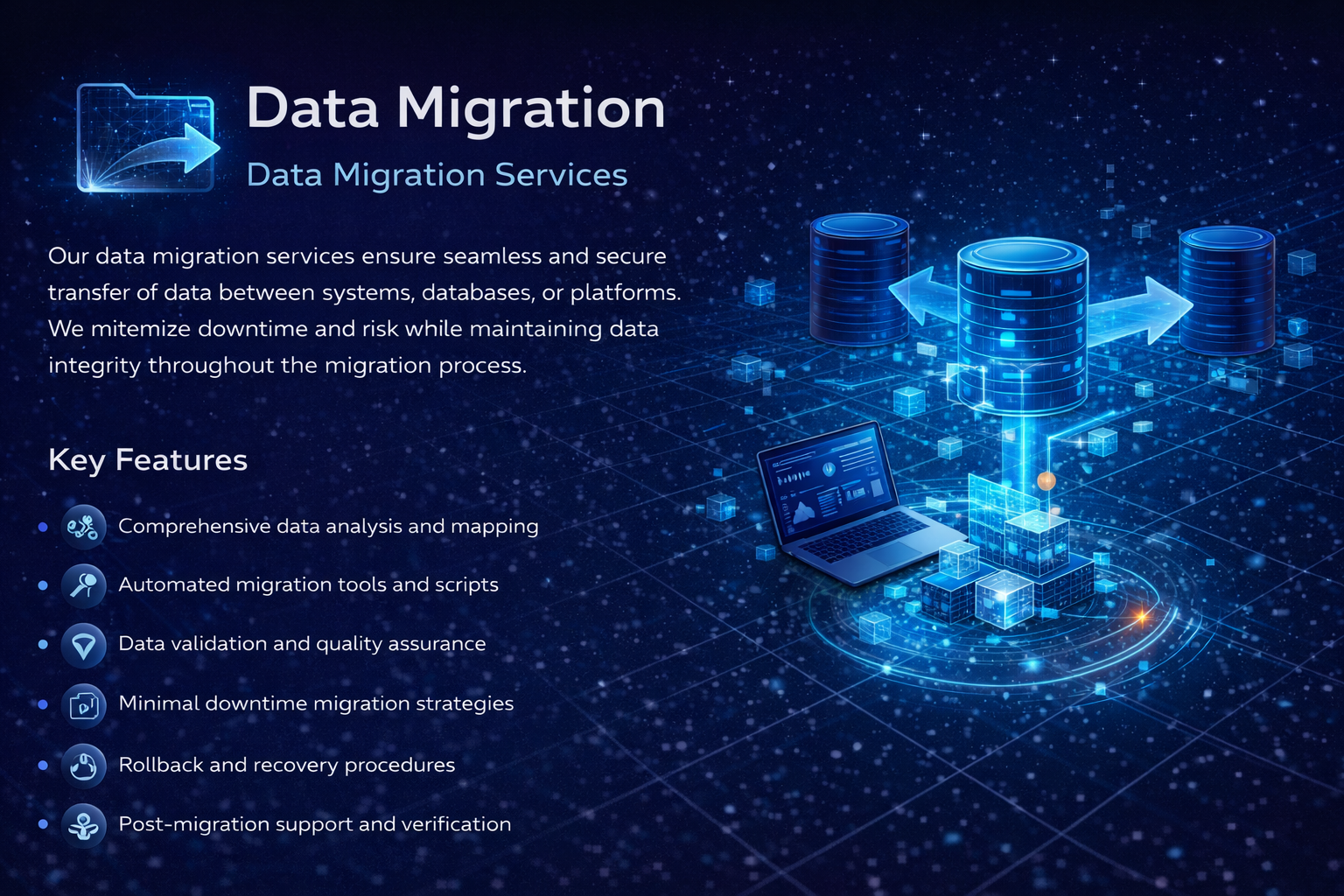
Our Data Migration Services enable organizations to securely and seamlessly transfer data across systems, databases, and platforms with minimal risk and downtime. We ensure data accuracy, integrity, and continuity throughout the entire migration lifecycle, allowing your business to transition confidently to new technologies or environments.
Using proven methodologies, automation, and best practices, we deliver reliable migrations that support operational stability and future scalability.
Key Features
- Comprehensive Data Analysis & Mapping: In-depth assessment of source and target systems to define accurate data mappings, dependencies, and transformation rules.
- Automated Migration Tools & Scripts: Use of automated tools and custom scripts to accelerate migration, reduce manual errors, and improve consistency.
- Data Validation & Quality Assurance: Rigorous validation checks before, during, and after migration to ensure completeness, accuracy, and data quality.
- Minimal Downtime Migration Strategies: Carefully planned migration approaches, including phased and parallel migrations, to ensure uninterrupted business operations.
- Rollback & Recovery Procedures: Well-defined rollback plans and recovery mechanisms to quickly restore systems in case of unexpected issues.
- Post-Migration Support & Verification: Comprehensive post-migration testing, reconciliation, and support to confirm system stability and data correctness.
How Spainik Can Help
At Spainik, we manage end-to-end data migration projects with precision and reliability, ensuring your critical data is transferred securely and accurately.
Our approach includes:
- Detailed migration planning and risk assessment
- Secure data handling and compliance alignment
- Automated and scalable migration execution
- Continuous monitoring and validation
- Ongoing support to ensure a smooth transition
With Spainik's Data Migration Services, you can:
- Reduce migration risks and errors
- Minimize downtime and business disruption
- Preserve data integrity and security
- Ensure smooth system transitions
- Build a strong foundation for future growth